
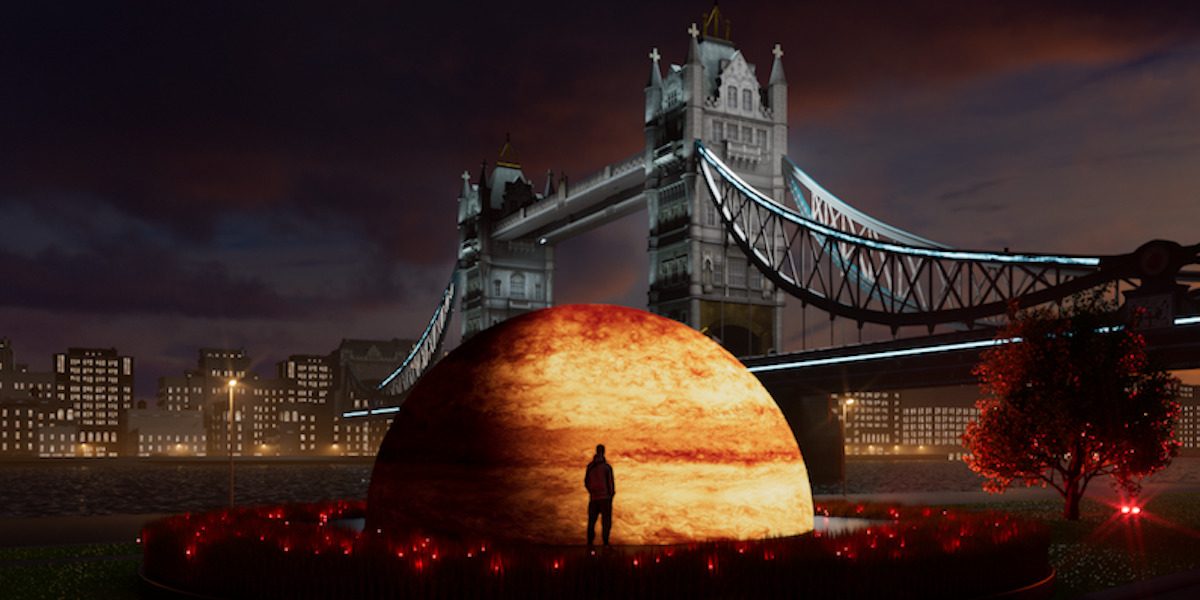
A stage set built for television doesn’t survive being trucked to five different cities and rebuilt in a car park. A gallery installation doesn’t need to hold up an eight-metre branded structure in high wind on a festival site. Large scale event installation design in the UK has to work in that gap, between theatrical craft and industrial durability. Marketing teams commissioning a big brand moment need a partner who understands both.
Most agencies and hire companies don’t offer this service. It sits between fine art fabrication and generic marquee hire. It’s built for brands that want to be seen, remembered, and photographed.
Go Big: What Large Scale Event Installation Design Actually Means
Large scale event installation design means creating a physical, branded structure built specifically for a campaign, launch, or activation. It’s not a stock stand pulled from a warehouse, and it’s not a sculpture made for a gallery wall. It’s a bespoke build. We engineer it to carry a brand message at scale, to survive transport, and to go up on a fixed deadline.
For marketing teams, that distinction matters commercially. A generic event hire company can supply a marquee or a stage. An art installation studio can make something beautiful and site-specific. Neither is set up to turn a campaign brief into a structurally sound, brand-accurate build that tours multiple venues and gets struck on schedule.
Where Art Installations End and Brand-Led Builds Begin
Art installations are usually one-off, gallery-curated, and built to a creative brief with no commercial deadline attached. Event hire is fast, flexible, and generic by design. The same modular stage or shell scheme works for almost any client.
A brand-led build sits apart from both. It starts with a campaign objective, not a curatorial concept. It has to survive touring, load-in windows, and venue restrictions. And it has to look exactly like the brand every single time it goes up, whether that’s a launch in London or a tour stop in Manchester.
Bespoke Event Structure Design for Brand Campaigns
Bespoke event structure design starts with a campaign brief, not a catalogue. A marketing team comes to us with a message, a budget, and a deadline. Our job is turning that brief into a structure that photographs well, holds up physically, and does what the campaign needs it to do.
That’s a different discipline from renting a shell scheme. We engineer a structure from scratch, choose materials that suit the venue and the run of the campaign, and build the branding into the fabric of the piece rather than bolting it on afterwards.
Giant Props & Scenic Fabrication
Giant props are one of the clearest expressions of branded event installation work. An oversized product replica, a scaled-up piece of packaging, or a themed scenic backdrop all demand the same thing: precision at a size most fabricators never work at.
Building at that scale isn’t just “bigger.” It changes the engineering, the materials, and the way a piece gets transported and rigged on site. This is where scenic craft rooted in theatre design pays off. The same discipline used to build sets that move, tour, and hold an audience’s attention now goes into building props that carry a brand’s message at festival or launch scale.
Immersive Experience Design for Brand Activations
Beyond single props, large scale builds increasingly form full immersive environments, walk-through spaces where guests experience a brand rather than just look at a logo. This kind of experiential design blends staging, lighting, and scenic fabrication into one coherent journey.
Readers exploring this further can look at immersive brand experience design as a wider service that sits alongside single large-format builds.
End-to-End Event Installation Production in the UK
The biggest risk in a large build isn’t the design. It’s the handoff. A design studio hands a concept to a fabricator, who hands the finished piece to a logistics company, who hands it to an installation crew. Every handoff is a chance for something to go wrong, slip the schedule, or drift from the original brief.
End-to-end event installation production in the UK solves that by keeping one team responsible from first sketch to final strike. We design, build, and install large scale event installations from a 17,000 sq ft facility in Essex, just outside London, so we keep full control over fabrication quality and lead times.
From Concept Sketch to Site Handover
The process typically runs through concept design, technical drawing, in-house fabrication, transport, on-site install, and eventual strike. Because it’s the same team at every stage, changes made in fabrication feed straight back into the design. There’s no lengthy approvals loop between separate suppliers.
Readers who want the fuller breakdown of that process can see how an experiential installation is actually built from first sketch through to on-site handover.
Managing Logistics, Safety and Touring
We build giant props and touring scenic installations in-house, so one team carries the design through fabrication, logistics, and on-site installation without handoff risk. That matters most on multi-venue tours, where a structure has to be de-rigged, transported, and rebuilt correctly at every stop, on a schedule that rarely allows for a second attempt.
Health and safety sign-off, site access surveys, and structural certification all sit inside this same process rather than getting outsourced separately. That’s one of the main reasons brands choose a fabrication-led partner over a standard hire company.
Large Format Event Build: Materials, Scale and Practical Limits
Every large format event build runs into the same practical questions: how big can it go, what’s it made from, and will it fit through the venue doors?
Scale is usually limited by the venue itself rather than by fabrication capability. Ceiling height, door widths, floor loading, and weight limits on suspended rigging all shape what’s possible before anyone makes a single material decision. A good production partner surveys the site early and designs around those constraints rather than discovering them on install day.
Material choice depends on whether a piece tours or stays put. A one-off installation for a single launch can use lighter, less durable materials than a structure built to survive repeated transport and rebuild across a touring schedule. Timber, steel framing, moulded foams, and printed fabric skins are all common. We choose between them based on the balance of weight, finish, and durability the brief demands.
Timelines vary with complexity, but as a rule the bigger and more bespoke the build, the earlier a marketing team needs to bring a fabrication partner into the conversation. Ideally that’s at brief stage, not once the venue is already booked.
Planning an Experiential Event Set Build in the UK
A good brief makes the difference between a smooth build and a stressful one. The most useful briefs give a fabrication partner the campaign objective, the venue constraints, the budget range, and the hard deadline up front, rather than a finished design to simply quote on.
It also helps to bring the fabrication team in before the venue contract is signed. Structural limits, access routes, and load-in times all affect what’s realistically buildable. Catching those constraints early avoids expensive redesigns later.
For a full walkthrough of what to include, briefing an experiential production company covers the practical detail marketing teams often miss.
Choosing a Fabrication Partner Over a Hire Company
A short checklist helps here. Does the partner design and build in-house, or subcontract fabrication out? Do they have a facility big enough to build at the scale the campaign needs? Can they show past work at a comparable size and complexity? And do they manage logistics and install themselves, or hand that off to a third party?
A hire company can move fast on standard kit. A fabrication partner is the better choice when the brief calls for something bespoke, brand-accurate, and built to survive more than one outing.
Why Brands Choose Scene2 for Large Scale Installations
A husband-and-wife theatre design team founded Scene2 in 1999. We bring scenic craft, not generic exhibition-stand thinking, to large format builds. That theatre pedigree shows up in how we engineer the work: pieces designed to move, tour, and perform under audience attention, not just sit still for a photo.
Our client roster includes Netflix, NBC Universal, Coca-Cola, John Lewis, and Absolut, brands that commission large scale builds for high-visibility campaigns. Brands looking at a similar scale of ambition sometimes also explore pop-up shop fabrication in Essex alongside a large event installation, as both draw on the same in-house design and build capability.
If a campaign needs a build that gets noticed, holds up, and lands on time, get in touch with Scene2 to start the conversation. Go big, and go with a team that carries the project from first sketch to final strike.